Macro Signals to Actual Trades
There is a point where every macro framework either earns its keep or quietly fails.
Not in the backtest.
Not in the chart deck.
But at the moment where you have to decide whether to put real risk on.
Most macro tradoors or punters never actually cross that bridge. They build elegant narratives, identify the right themes, even get the direction broadly right and still struggle to generate consistent P&L. The reason is simple, frameworks don’t trade themselves.
What matters is how a view gets expressed, how risk gets sized, and how uncertainty gets respected.
This execution series is about that translation layer, the step between “I think” and “I’m positioned.”
The First Principle: I’m Not Trying to Be Right, I’m Trying to Be Aligned
I don’t wake up asking where the market will be in six months. I wake up asking whether the current configuration of signals supports or punishes risk.
Markets don’t pay you for having the correct macro story. They pay you for being aligned with the dominant transmission mechanism at that moment in time. Sometimes that’s growth. Sometimes inflation. Sometimes liquidity. Sometimes simply the absence of stress.
So the output of my framework is not a forecast.
It’s a bias.
A bias answers a narrower, more useful question:
If I put risk on today, am I being helped or fought by the macro structure underneath me?
This distinction is what allows me to stay flexible without being reactive.
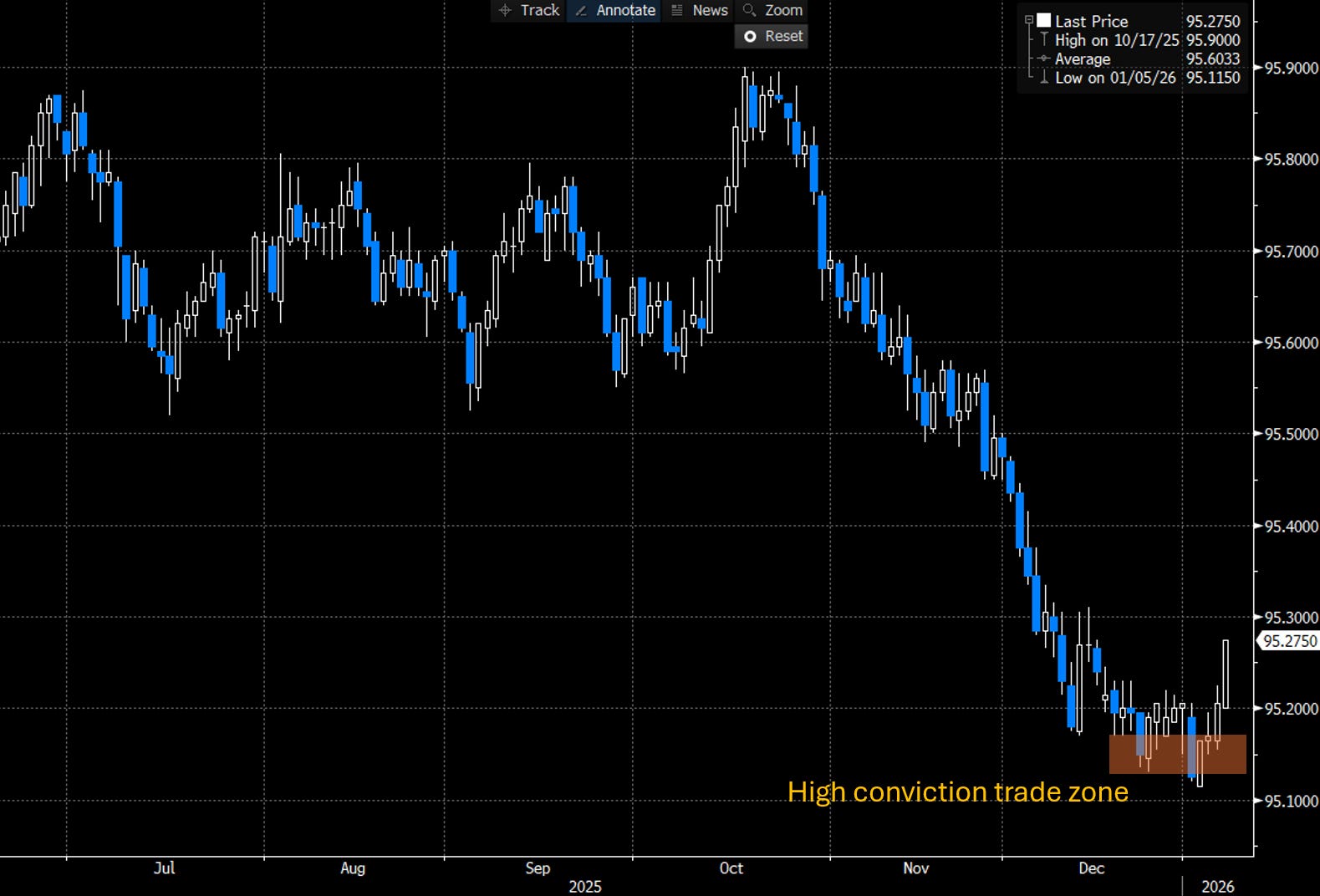
A recent example is the Australian 10-year: yields were pushed to an extreme after a hotter CPI print. In my view, the market extrapolated that surprise too far and the repricing was overdone. Australia remains AAA-rated, and while inflation is still uncomfortably high, it is broadly consistent with a wider G10 disinflationary trend, just with more near-term noise.
The asymmetry is straightforward. If policy stays “higher for longer,” the transmission into the real economy is likely to bite harder and pull growth toward the edge, which ultimately caps long-end rates. And if inflation momentum rolls over, the curve has to reprice lower regardless, because the market can’t justify paying extreme term yields when the inflation pulse is fading.