

Firstly, Happy Easter all…. please see a discount option below if you are interested to follow and support the site. Below is a write up and two macro trade ideas NQ and Sofr Dec25
In markets, it’s not just the price that matters, it’s how many names are participating, what credit is signaling underneath, and whether rates markets confirm the move. This week, the narrative snapped: breadth collapsed, credit spreads widened to levels not seen since early 2023, and equity futures though recovering off the lows, remain vulnerable in the face of policy hesitancy and trade policy chaos. If you're looking for a clean trend or rotation, you won’t find one. What we’re seeing is a fragility that spans sectors, timeframes, and asset classes.
Anatomy of a Breakdown: Equity Breadth and Sector Correlation
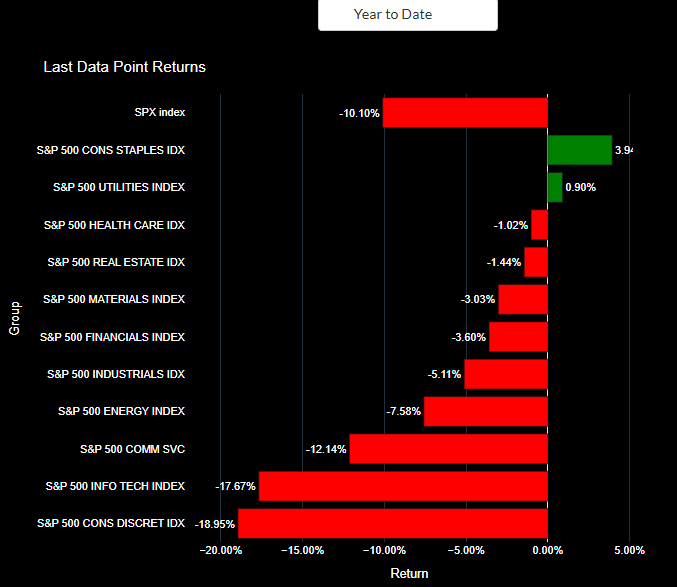
The S&P 500’s recent -1.24% decline wasn’t just a function of headline-sensitive tech stocks giving back gains. It was a systemic event broad, deep, and coordinated across sectors.
Information Technology dragged the index most heavily (-0.41%) but this wasn’t a lone wolf story.
Financials, Discretionary, and even Staples joined the retreat in lockstep.
Crucially, no sector rotated in to provide shelter even classic defensives like Utilities and Real Estate faltered.
Breadth collapsed across 10-, 20-, and 50-day measures. This is not short-term noise it’s structural weakness.
This sort of cross-sector liquidation typically signals a macro-driven stress event rather than a healthy correction. There's no rotation; just exit.
Credit as the Canary: IG Spreads Break Higher
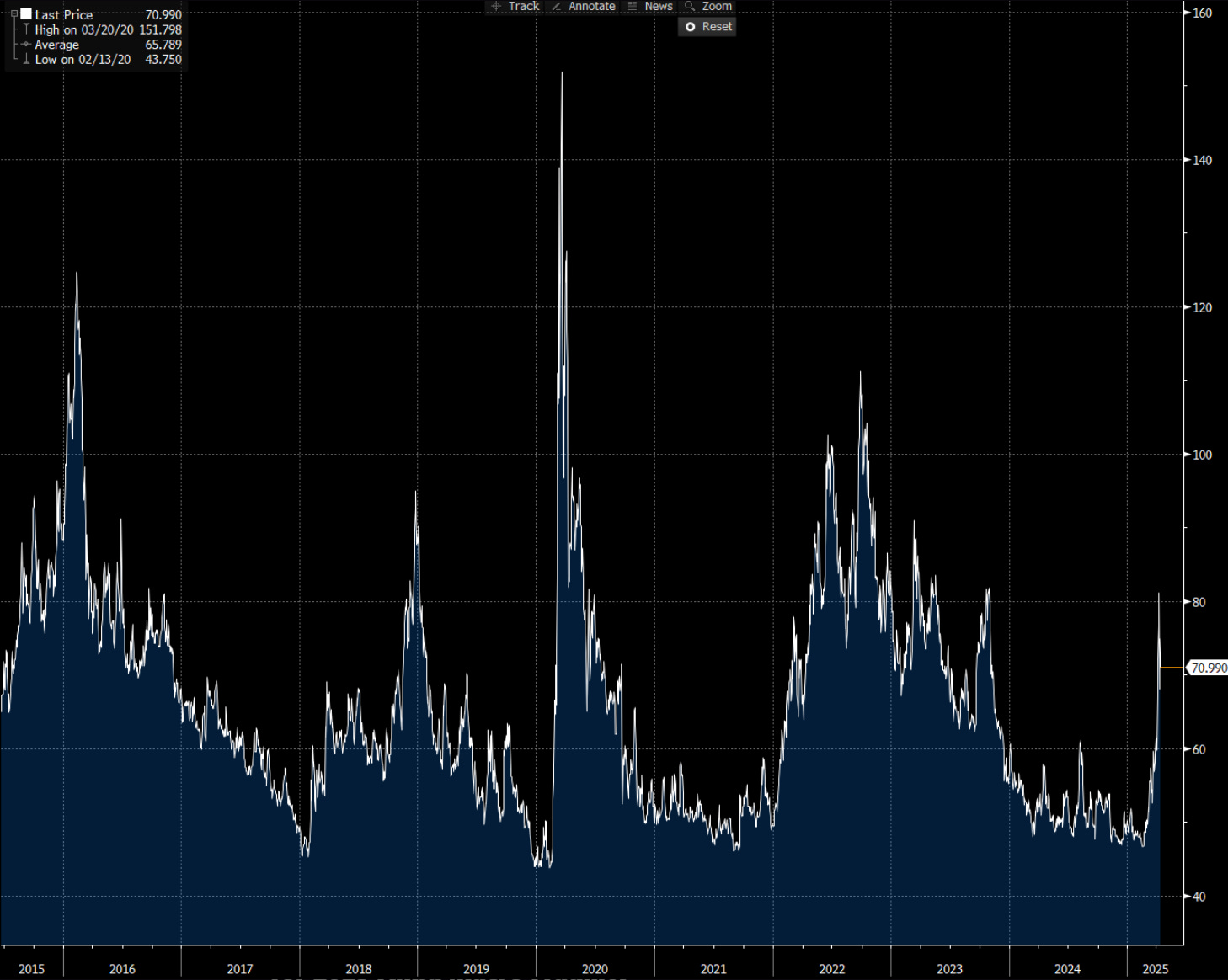
Investment Grade credit spreads have widened to 71.76 bps, their highest in over a year, and notably above their long-run average of 65.77 bps. This is not a credit-default story—there’s no Enron hiding here. What we’re seeing is a repricing of macro risk and the rising cost of capital amid fading liquidity and confidence.
“Spreads are functioning as the new VIX—only they’re slower and more persistent.”
The acceleration in spread widening reflects not just risk aversion in equities, but tangible transmission of stress across the capital structure. That should worry anyone holding cyclical equity risk.
Short-End Rates: A Tense Truce Between Powell and the Market
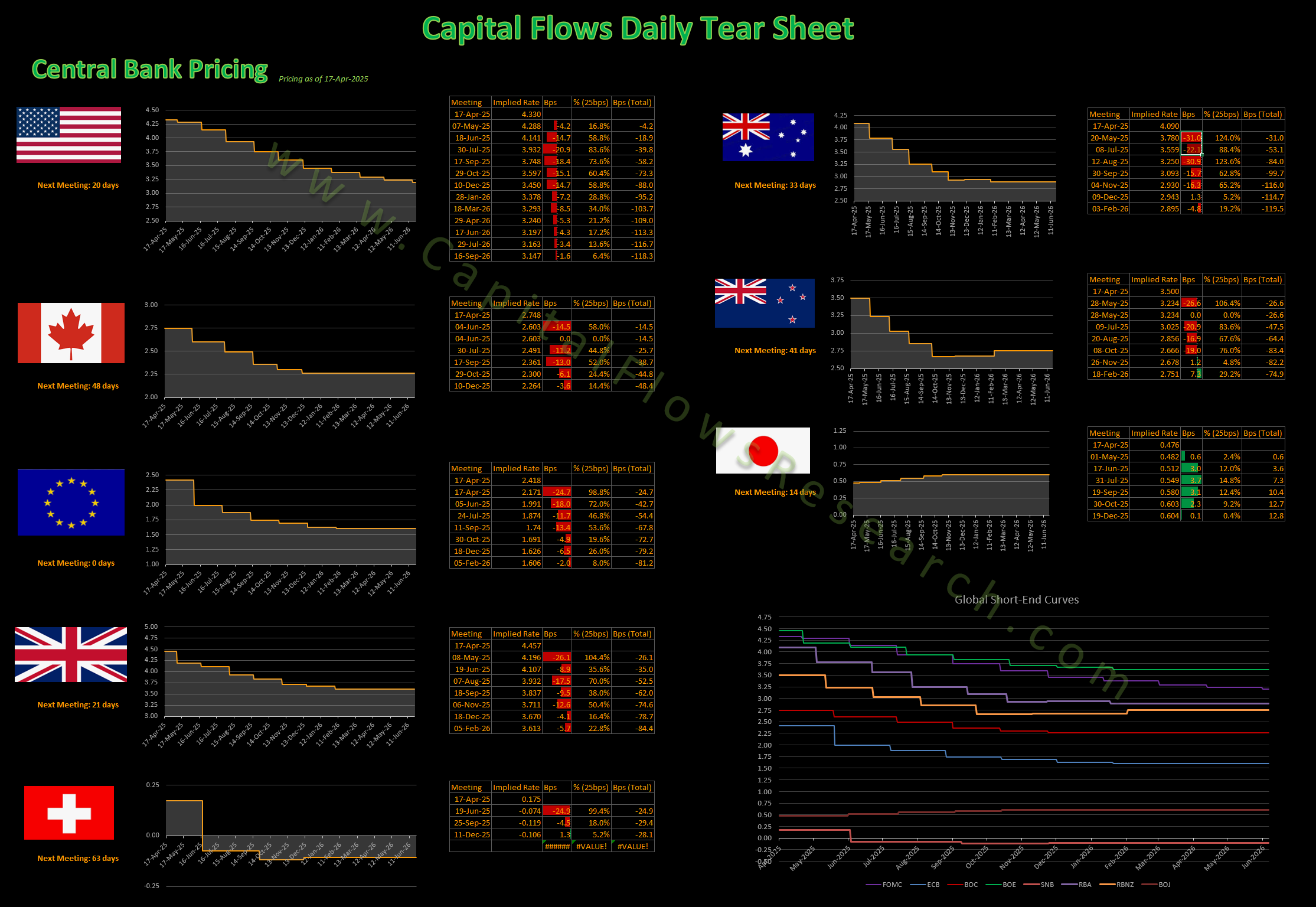
*Used with the ok from Capital Flows.
Despite Powell’s insistence that “price stability is non-negotiable,” short-end futures are now pricing in 91.4 bps of Fed easing by year-end 2025. Most of it is front-loaded into Q3, a clear market message: the Fed will be forced to cut, regardless of its narrative.
This dovish pricing is global:
RBA leads with 119 bps priced
ECB and BoE not far behind (~80 bps)
Only BoJ is in tightening mode (+8.7 bps)
Markets are projecting synchronized easing even as central bankers push back. Someone’s wrong and the repricing across breadth, credit, and volatility suggests the market may be early but not wrong.
Macro Underpinnings: Tariffs, Trade, and the Inflation Dagger
Retail sales surged 1.4% in March, the fastest in two years. But the driver wasn’t prosperity, it was panic. Consumers, reacting to looming tariffs, front-loaded purchases of autos and electronics.
This is a dangerous dynamic:
Tariffs create artificial demand spikes, pulling consumption forward.
That temporarily supports growth and prices but leaves a vacuum afterward.
Meanwhile, the inflationary impact lingers, challenging central bank credibility.
Trump’s erratic trade policy has injected headline volatility into what was already a fragile equilibrium. Powell’s challenge is now multidimensional: protect credibility, avoid policy error, and do so while the President criticizes him daily on social media.
Futures Positioning and Technical Landscape
Looking at the visual layout of global futures (see attached image), three key patterns emerge:
Equities (S&P, Nasdaq, Nikkei) bounced, but still sit below March levels, with lower highs forming across the board. These are bear market rallies, not bullish reversals.
Rates (2s, 5s, 10s, 30s) are stabilizing with a modest bull steepening bias, suggesting that rate cuts are increasingly expected in response to macro deterioration, not policy victory.
Commodities (Oil, Gold, Nat Gas) show divergent narratives:
Oil and Copper are firm, reflecting geopolitical tension and some risk premia.
Gold remains strong despite real rates—hedging behavior is increasing.
Final Thoughts: Where We Go from Here
Markets are now being driven by macro fragility, not idiosyncratic or corporate news flow. Breadth has collapsed. Credit is tightening. Equity volatility is rising. Yet rate markets are pricing salvation from central banks… just not yet.
This is a dangerous place to be structurally long risk assets. There is no rotation to hide in, no yield cushion to lean on, and no clear catalyst for relief beyond hope for policy error.
If Powell holds firm, volatility will persist. If he caves too soon, inflation risks resurface. Either way, the next 4–6 weeks will be crucial for determining whether we see a liquidity-driven rally or a volatility-driven reset.
