

Highlights:
2026 so far
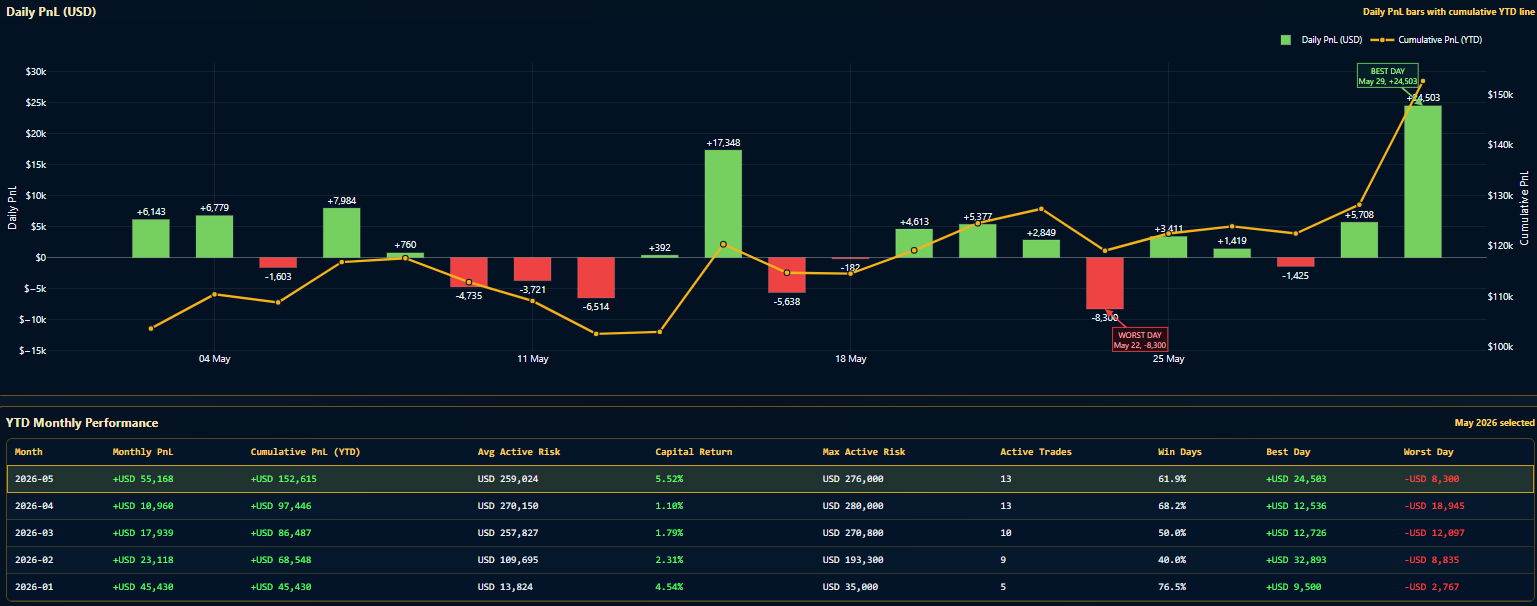
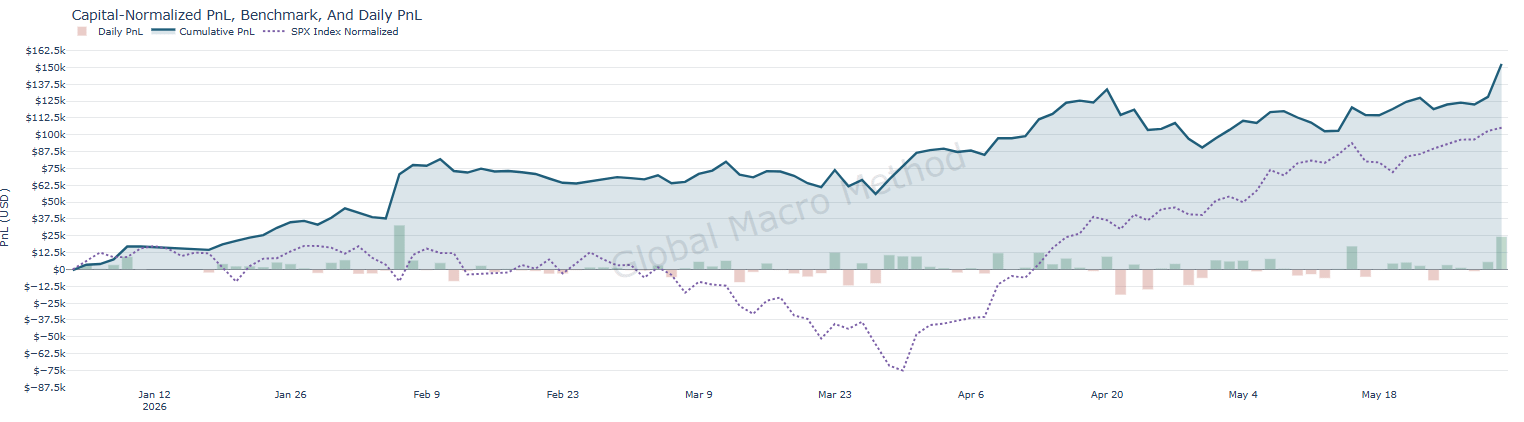
Jan (+4.54%), Feb (+2.31%), Mar (+1.79%), Apr (+1.10%), May (+5.52%)
Total: +15.3%


Monthly Overview: Markets Rally, But Macro Risks Refuse to Fade
May was a strong month for risk assets, but it was not a clean “goldilocks” rally. Equity markets pushed to fresh highs, powered by resilient earnings, renewed enthusiasm around AI-linked capital expenditure, and a late-month fall in oil prices. At the same time, the macro backdrop became more complicated, inflation re-accelerated, bond yields stayed elevated, central banks remained cautious, and geopolitical risk continued to feed directly into energy and rates markets.
In short, May was a month where markets looked through a lot of bad news, but did not entirely escape it.
Equities: momentum wins again
US equities finished May on a strong footing. On the final trading day of the month, the S&P 500 closed at 7,580.06, the Dow Jones Industrial Average at 51,032.46, and the Nasdaq Composite at 26,972.62. The S&P 500 also recorded its ninth straight weekly gain, while the Nasdaq continued to lead on the back of technology and AI-related strength.
The headline numbers were impressive. The S&P 500 rose around 5.2% in May, while the Nasdaq gained roughly 8.4%. Over April and May combined, the Nasdaq was up about 25%, its best two-month stretch since 2002, while the S&P 500 gained about 16% over the same period.
The key driver remained earnings. Goldman Sachs lifted its year-end S&P 500 target to 8,000 during the month, citing stronger corporate earnings and estimating that AI infrastructure beneficiaries could drive around half of the index’s earnings growth this year.
That said, the rally was still narrow in character. Mega-cap technology, semiconductors, AI infrastructure, and high-momentum stocks continued to dominate index-level performance. That leaves the market vulnerable to any disappointment in earnings revisions, capex guidance, or long-duration equity valuations if bond yields rise again.
Bonds: yields remain the market’s pressure valve
Rates were again central to the market narrative. The US 10-year Treasury yield ended May around 4.45%, after reaching 4.67% on May 19. That move captured the tension running through the month, investors wanted to price a soft landing and strong earnings, but the bond market kept pushing back against the idea that inflation risk had disappeared.
The Federal Reserve did not meet in May, but the April 29 FOMC statement and the minutes released during the month reinforced a data-dependent stance. The Fed held the target range for the federal funds rate at 3.50%–3.75%, noted that inflation remained elevated, and specifically cited uncertainty tied to developments in the Middle East and global energy prices.
The important point for markets is that the Fed is no longer dealing with a simple disinflation story. Growth is still positive, labour markets are cooling rather than cracking, and energy has reintroduced upside inflation risk. That mix makes the hurdle for rate cuts higher and keeps yields highly sensitive to incoming inflation data.
Key Positions:
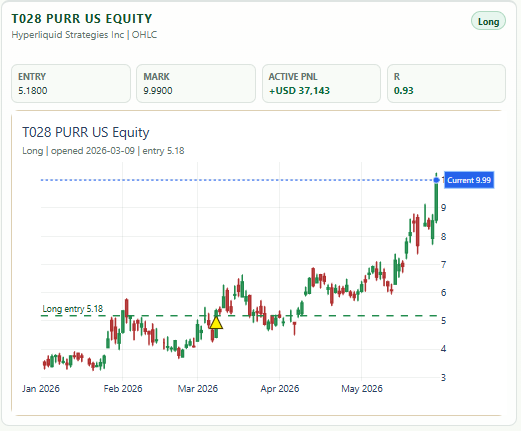
Positioning also helped at the single-name and rates level. PURR worked because it was effectively a high-beta proxy for the Hyperliquid ecosystem: as HYPE rallied, investors looked through PURR as a listed crypto-treasury vehicle with direct sensitivity to HYPE holdings and staking economics. That move was further supported by the broader legitimisation of perpetual futures market structure, including the CFTC’s approval of Kalshi’s BTCPERP contract, the first US-regulated bitcoin perpetual futures contract.
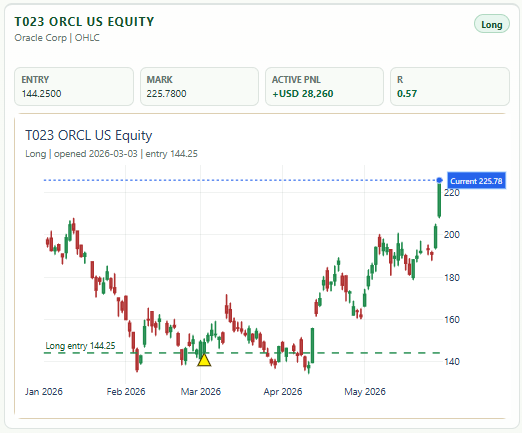
ORCL was a more straightforward AI-infrastructure winner. Oracle’s latest results reinforced the market’s view that the company has become a scarce supplier of enterprise AI compute: Q3 FY26 revenue rose 22%, cloud revenue rose 44%, OCI revenue rose 84%, and remaining performance obligations surged 325% year over year. That backlog strength gave investors confidence that AI demand is translating into contracted revenue rather than just narrative momentum.
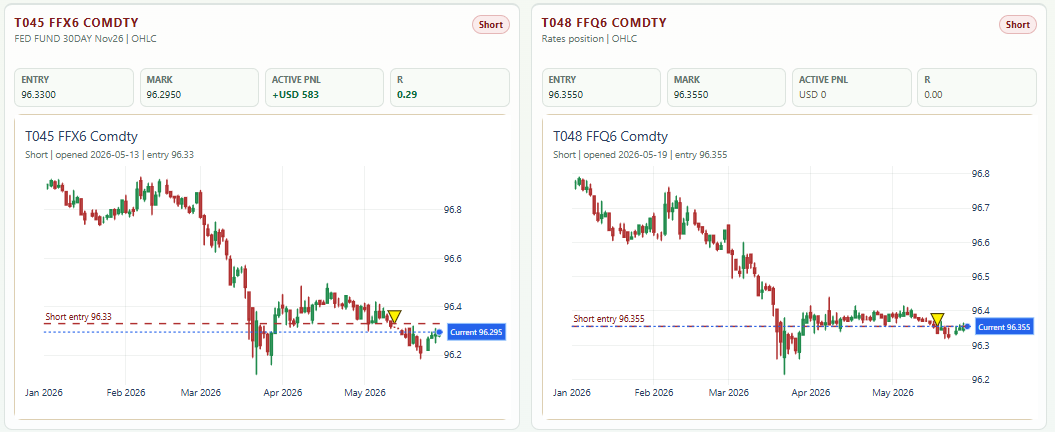
In rates, shorts in short-dated Fed funds continue to offer attractive asymmetry. The trade is essentially short the front-end easing narrative: if inflation and energy risks keep the Fed on hold, or force the market to price a higher probability of hikes, Fed funds futures can reprice materially lower. But if growth softens, the Fed’s ability to validate aggressive cuts is still constrained by elevated inflation and its own data-dependent communication,
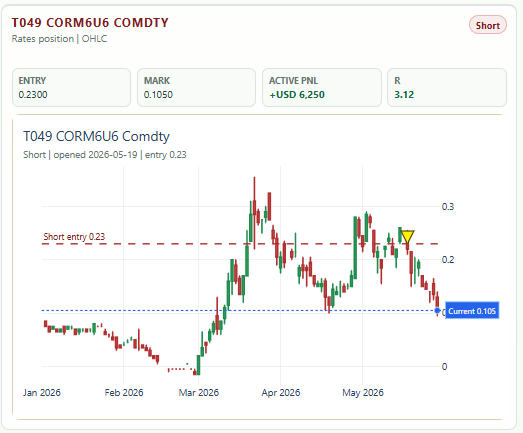
In Canada, the short-dated CORRA flattener remains a clean expression of weaker domestic data without needing to take outright duration risk. April labour data softened, with unemployment rising to 6.9%, while Q1 real GDP was flat and headline CPI acceleration was largely energy-driven, with CPI excluding gasoline slowing to 2.0%. That mix supports a flatter short-end curve: near meetings can remain anchored by the BoC’s caution around energy and trade uncertainty, while the forward path should increasingly reflect softer growth and rising slack.