


What is happening with inflation!
(Sorry for the delay on getting this out, there is a new trade at the bottom, i expect a favourable fill will be available when US session opens next)
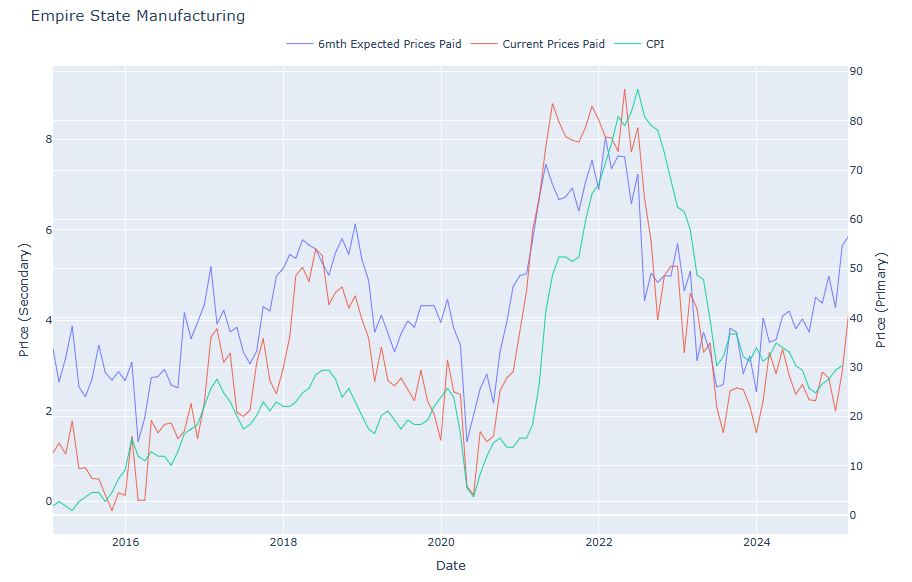
The latest Empire State Manufacturing data provides an intriguing look at how manufacturers’ future price expectations, current prices paid, and broader consumer inflation (as captured by the CPI) move in tandem—yet sometimes diverge. Over the last few years, the 6-month expected prices (blue line) and current prices (red line) have both experienced dramatic swings. In 2022, both measures spiked significantly, coinciding with a surge in the CPI (green line), hinting at mounting inflation pressures. After reaching those peaks, all three measures gradually moderated, signaling a broad cooling in price pressures. However, the 6-month expected prices have started climbing again, suggesting businesses might be bracing for renewed cost challenges.
This interplay between what manufacturers expect they’ll have to pay in the near future and what they are paying now offers important clues about where inflation could be heading. When the expected prices line jumps well in advance of rising current prices, it often points to building inflation pressures that eventually show up in the official CPI. On the flip side, if current prices subside while expectations remain tempered, that can mean some breathing room for consumers and policymakers. Right now, with the CPI showing a more modest rise compared to the recovery in manufacturers’ expectations, the question is whether broader consumer inflation will follow suit. Policymakers, investors, and businesses alike will be watching these lines closely to gauge just how persistent inflation might be in the months ahead.
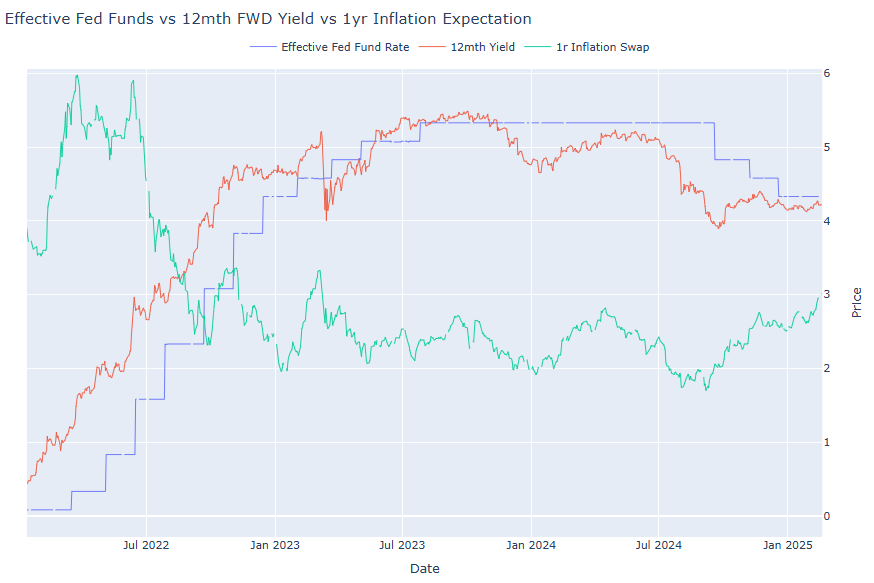
This chart shows how the market is perceiving the interplay between the Federal Reserve’s actual policy rate (the effective fed funds rate in blue), short-term yields (the 12-month yield in red), and near-term inflation expectations (the 1-year inflation swap in green).
The Fed funds rate has clearly ratcheted higher from near-zero levels in mid-2022 to around 5%, while the 12-month yield initially kept pace, then leveled off slightly as traders began pricing in eventual rate cuts. Meanwhile, the 1-year inflation swap dipped significantly in late 2022 and early 2023—likely reflecting fading panic about runaway inflation—yet it’s been climbing again, suggesting markets see inflation staying somewhat sticky rather than falling straight back to the Fed’s 2% target. The net takeaway: despite the Fed’s steep tightening cycle, markets are still wary about inflation reemerging, and they’re balancing that concern against the growing sense that the Fed may have to soften policy to keep growth on track.
Inflation-Defensive Trades and Strategies
Inflation doesn’t just raise the cost of living—it can also eat into your investment returns if you’re not prepared. When prices climb, certain assets tend to either keep pace with inflation or protect your capital from getting eroded. From Treasury Inflation-Protected Securities (TIPS) to commodity plays, there are multiple ways to bolster your portfolio against rising prices.
Below are some core strategies often considered “inflation defensive.” These aren’t one-size-fits-all solutions—everyone’s financial situation and risk appetite is different—but they can serve as a strong starting point for your research:
