

Understanding Market Pricing
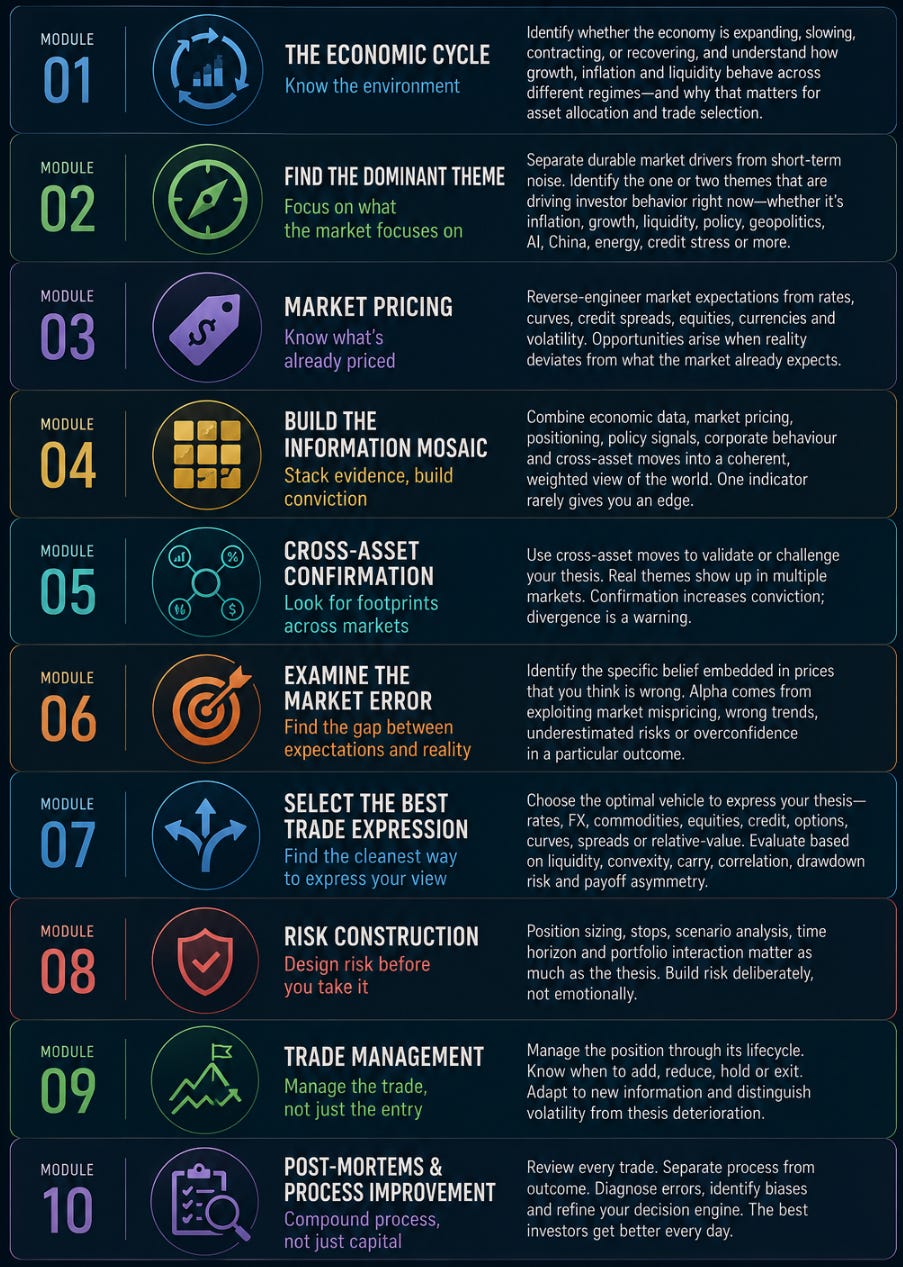
In Part 1 of the Macro Decision Engine, we started with the cycle.

Before risking capital, you need to understand the environment you are operating in. Growth, inflation and liquidity behave differently across different regimes, and the same data point can have completely different market implications depending on whether the economy is expanding, slowing, contracting, or recovering.
In Part 2, we moved from the cycle to the dominant theme.

The cycle tells you the environment. The theme tells you what the market actually cares about inside that environment. Sometimes the dominant theme is inflation. Sometimes it is growth. Sometimes it is liquidity, policy credibility, fiscal risk, geopolitics, earnings, AI, energy, China, credit stress, or positioning.
But even that is still not enough.
You can understand the cycle correctly. You can identify the dominant theme correctly. You can even have the right macro view.
And still lose money.
Because markets do not reward you for having a good story. They reward you when reality turns out differently from what was already embedded in prices.
That is why the next step in the Macro Decision Engine is understanding market pricing.
This is where macro analysis becomes market opportunity.
Being Right Is Not Enough
One of the most important lessons in trading is that being right is not the same thing as making money.
A trader can correctly identify that inflation is falling, but if the market has already priced a clean disinflation path, the opportunity may be limited. A trader can correctly identify that growth is slowing, but if bonds have already rallied, curves have already steepened, credit has already widened and equities have already de-rated, the trade may be late. A trader can correctly identify that central banks are likely to cut rates, but if the market has already priced those cuts aggressively, the risk may actually be in the other direction.
This is why the question is never simply, “What do I think will happen?”
The better question is, “What does the market already believe will happen?”
And then, “Where do I disagree?”
That gap between your view and market pricing is where opportunity lives.
A macro view only becomes tradable when there is a misalignment between expectations and reality. If your view is already consensus, already reflected in positioning and already embedded in prices, then being right may not be enough. The market may need you to be more right, faster than expected, or right in a way that changes the path of future expectations.
That distinction matters.
The market does not pay you for describing the world correctly.
It pays you for identifying where the world will differ from what prices imply.
Every Price Is an Implied Forecast
The easiest way to think about markets is that every price contains an embedded forecast.
A bond yield contains expectations about inflation, growth, policy rates, term premium and risk appetite. An equity index contains expectations about earnings, margins, discount rates, liquidity and investor sentiment. A credit spread contains expectations about default risk, refinancing conditions, balance sheet stress and liquidity. A currency contains expectations about relative growth, relative rates, capital flows, external balances and risk appetite.
Prices are not random numbers on a screen.
They are compressed expressions of collective expectations.
This does not mean markets are always right. They are often wrong. But they are always saying something. The job of the macro trader is to understand what they are saying before deciding whether to disagree.
If the two-year yield is rising, the market may be pricing a more restrictive central bank path. If the yield curve is steepening, the market may be pricing future easing, higher term premium, stronger nominal growth, or fiscal risk. If credit spreads are widening while equities remain strong, the market may be sending conflicting signals about growth and risk appetite. If the dollar is strengthening, the market may be pricing relative growth outperformance, relative policy divergence, funding stress, or safe-haven demand.
The price is the starting point.
The interpretation is the work.
For more research and analysis please join, all paid membership give access to www.globalmacromethod.com the best in class dashboard for macro traders
