

Reviewing 24–28 August and looking ahead to 31 August–4 September
Jackson Hole put further tightening firmly into play without committing the Fed to a September decision. The question now is whether weak hiring reflects an economy running short of workers or one beginning to run short of demand.
The Week That Was:
The most useful number this week was not the 1.5% US GDP headline. It was the 4.2% annualised growth in private domestic demand underneath it. Consumer spending and private fixed investment were considerably stronger than the headline growth rate suggested, and that underlying measure was revised higher. Read the GDP headline alone and the economy looks vulnerable. Read the composition and the case for immediate policy relief becomes much harder to make.
That matters because the market is trying to reconcile two different stories, households and businesses are still spending, while employment growth has weakened. July’s payroll decline of 23,000 sits awkwardly alongside an unemployment rate of just 4.1%. Neither number, in isolation, resolves whether the economy is approaching a meaningful slowdown.
The more recent spending data added caution, but not a collapse. Real consumption was essentially flat in July, while real disposable income increased 0.4%. Headline PCE inflation remained at 3.7% year-on-year and core at 3.3%, with both rising 0.2% over the month. That is a softer start to third-quarter consumption alongside inflation that remains uncomfortable, not a clean combination of falling demand and rapidly disappearing price pressure.
My interpretation is that the economy has become more uneven, rather than uniformly weak. That leaves the Fed with a difficult judgement, how much weight should it place on deteriorating hiring when spending and investment are still holding up?
Warsh answered the policy side of that question at Jackson Hole. He characterised broad financial conditions as insufficiently restrictive, described the economy as resilient and put the immediate emphasis on restoring price stability. Crucially, he did not promise a September hike. But he challenged the assumption that some better inflation readings had already done enough to remove further tightening from consideration.
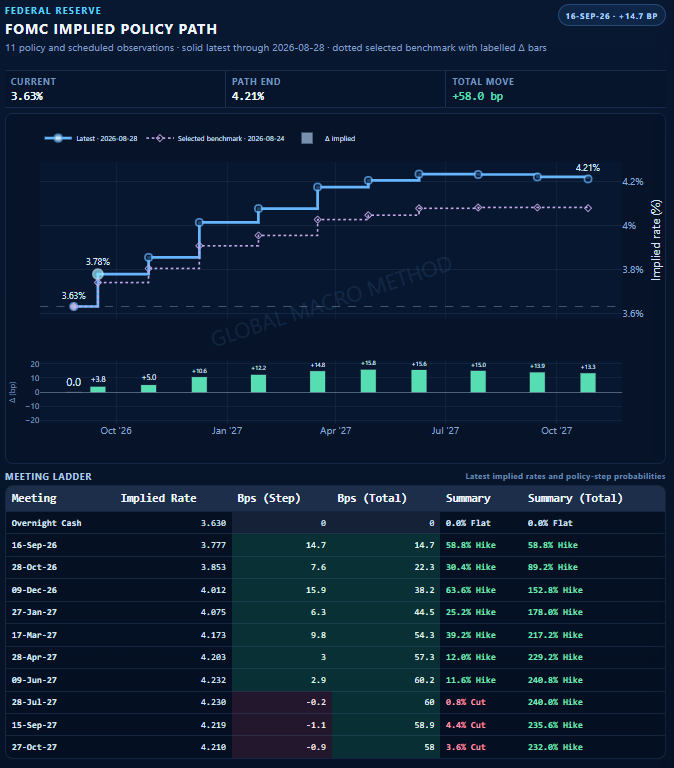
The immediate market reaction fitted that message. September hike odds rose from roughly 35% to 58%. 2yr yields climbed about 13 basis points on Friday, against 6bps at 10yrs and 2bps at yrs. That was a bear flattener, bonds sold off, but near-term policy risk took the bigger hit. The dollar strengthened and small caps underperformed. This was not a long-bond rally.
Nor was it a wholesale equity capitulation. The major US indices still finished the week higher despite Friday’s declines. That distinction matters when judging whether Jackson Hole changed the market’s underlying trend or merely interrupted it.
Nvidia supplied the other side of the argument. Quarterly revenue reached $96.2 billion, up 106% from a year earlier, providing substantial evidence that the AI investment cycle remains powerful. Those are actual revenues, not simply an optimistic story about future productivity.
However, strong AI demand does not make the entire equity market insensitive to interest rates. The companies receiving that spending can deliver exceptional results while businesses dependent on refinancing, housing activity or discretionary consumption face a much less forgiving environment.
For me, that is the week’s central message, strong earnings in one part of the market and a tighter policy outlook are not mutually exclusive. The mistake would be to treat either the technology rally or the weak payroll headline as a complete description of the economy.
Below, I look at how to separate near-term policy risk from long-end duration risk, why next week’s employment details matter more than the headline alone, and what would distinguish a healthy equity broadening from a narrow rebound. I also examine the different inflation problems facing Europe, Britain, Japan and Australia and the evidence that would make me abandon the current US interpretation rather than simply defend it.
Remember all paid subscribers gain access to a world class insto-grade macro dashboard at www.globalmacromethod.com
