

Weak payrolls, lower oil and strong earnings gave markets almost exactly the combination they wanted. This week, CPI, retail sales and heavy Treasury supply will determine whether that was a genuine macro shift or simply a well-timed relief rally.
Last week, markets bought into a very particular version of Goldilocks.
Oil prices fell sharply as hopes of progress around Iran and the Strait of Hormuz reduced the immediate energy tail risk. The US labour market then delivered an unexpectedly negative payroll print, pushing expectations for another Federal Reserve rate hike further out. At the same time, corporate earnings remained strong enough to prevent weaker employment from turning into a broader growth scare.
That combination was enough to send the S&P 500 to a record, pull Treasury yields lower and weaken the US dollar. Brent still finished Friday at US$83.55 per barrel and WTI at US$78.18, but both recorded heavy weekly declines after the market partially removed the geopolitical supply premium.
The problem is that the underlying macro data were not nearly as clean as the price action suggested.
US manufacturing activity strengthened materially. Services demand remained firm. Both ISM surveys showed unusually elevated input-price pressure. The labour market weakened, but not through a conventional wave of layoffs. Instead, the US increasingly resembles a low-hiring, low-firing economy in which output continues to expand while businesses become much more selective about adding workers.
The market did not trade a recession last week.
It traded a Fed with less immediate permission to tighten, while assuming that earnings and economic activity would remain largely intact. That is a much narrower proposition.
This week’s CPI, PPI and retail-sales reports will test whether the three parts of that proposition can continue to coexist: slower hiring, resilient demand and gradually easing inflation.
The Week That Was
The Payroll Report Changed the Timing, Not Necessarily the Regime
The headline number was unquestionably weak.
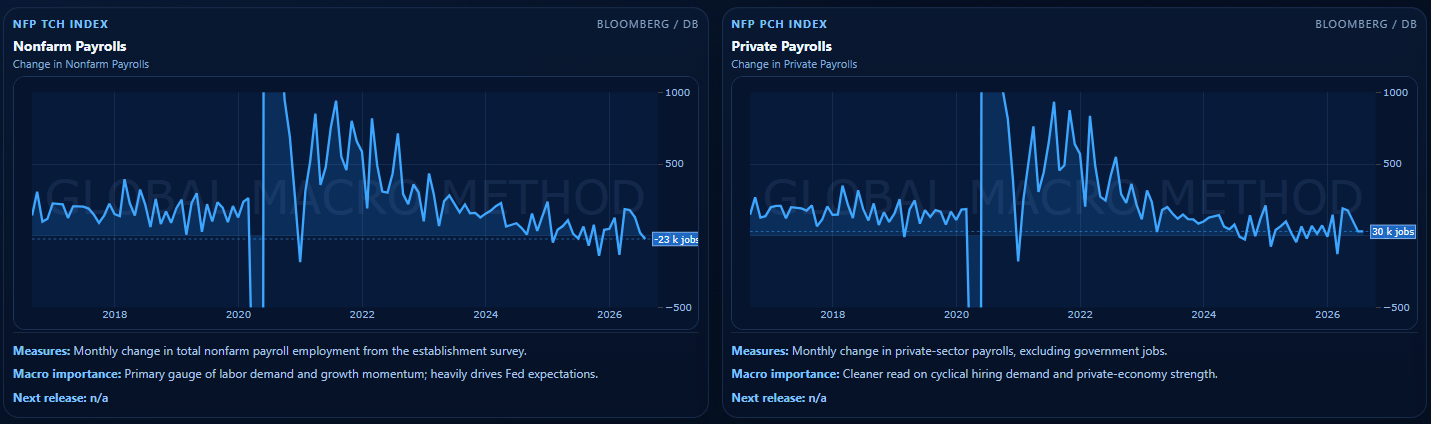
US nonfarm payrolls declined by 23,000 in July, against expectations for a gain. More importantly, May and June payroll growth was revised down by a combined 103,000. The average monthly employment gain over the previous 12 months is now just 34,000. Wage growth was relatively contained at 3.2% year-on-year.
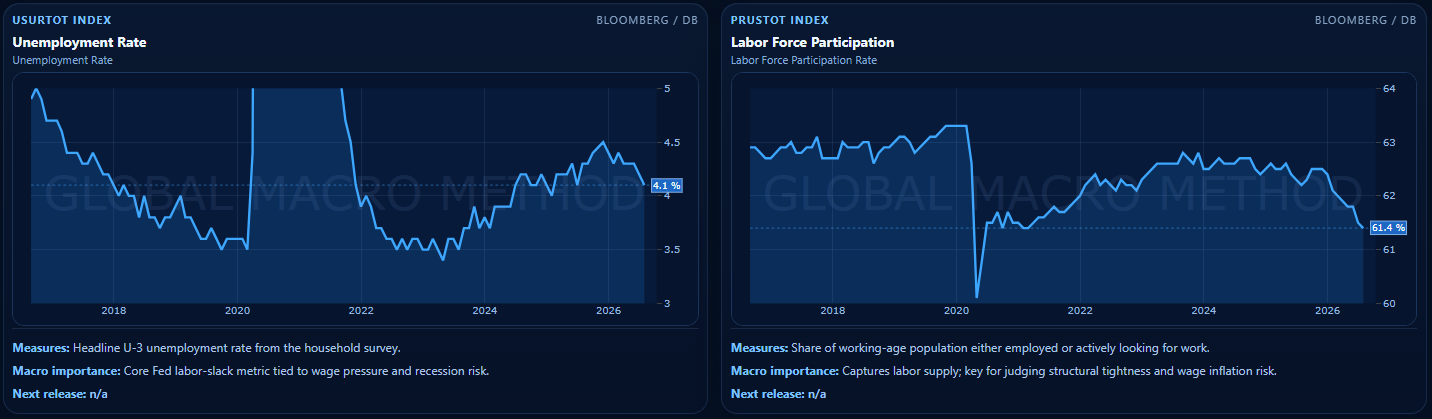
The unemployment rate nevertheless fell from 4.2% to 4.1%, but that was not an especially positive development. Labour-force participation fell to 61.4% and has declined by 0.7 percentage points since January. In other words, unemployment fell partly because fewer people were participating in the workforce, not because employment demand improved.
The immediate conclusion is that the labour market has weakened more than previously understood.
The more useful conclusion, however, is that the weakness remains concentrated in hiring rather than dismissals.
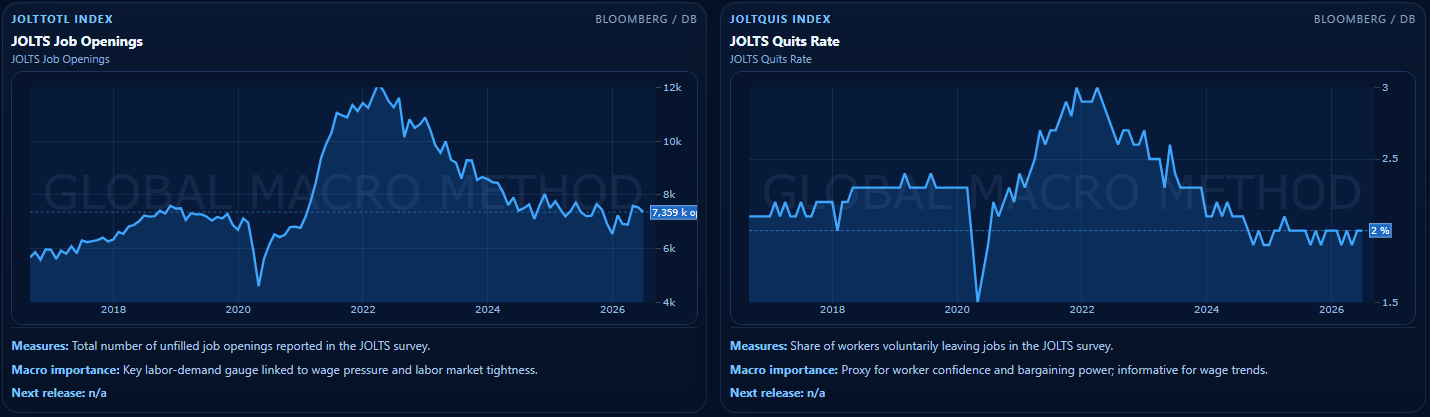
June JOLTS data showed 7.4 million job openings and 5.3 million hires, while layoffs and discharges were largely unchanged at 1.8 million. Initial unemployment claims were only 199,000 in the week ending 1 August, with the four-week average just below 199,000. Those are not numbers normally associated with an economy entering an aggressive employment contraction.
Businesses are not urgently shedding workers. They are simply reluctant to add new ones.
This matters for the Fed and for markets. A low-hiring environment can persist for some time without tipping immediately into recession, particularly when productivity is improving. Nonfarm productivity rose at a 1.4% annualised pace in the second quarter and was 2.2% higher than a year earlier. Unit labour costs increased only 1.4% year-on-year.
Higher productivity allows companies to produce more without increasing headcount at the same pace. It also provides some protection to profit margins and limits the inflationary effect of wages. That helps explain how payroll growth can deteriorate while economic activity and earnings remain relatively resilient.
The risk is that low hiring eventually becomes self-reinforcing. Workers become less confident about changing jobs, wage growth slows, consumption softens and businesses respond by reducing hiring further. We are not yet at that point, but the payroll report moved the economy closer to it.
Activity Was Stronger Than the Labour Data Suggested
The employment report was difficult to reconcile with the week’s business surveys.
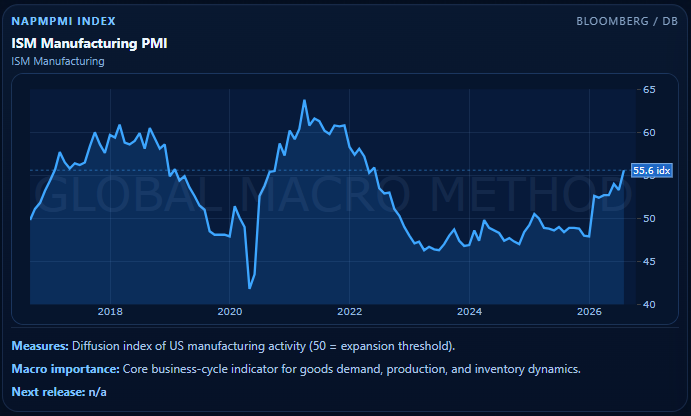
The ISM Manufacturing PMI rose from 53.3 to 55.6 in July, its highest reading since May 2022. New orders increased to 56.7, production jumped to 58.5 and the employment component returned to expansion for the first time in 33 months.
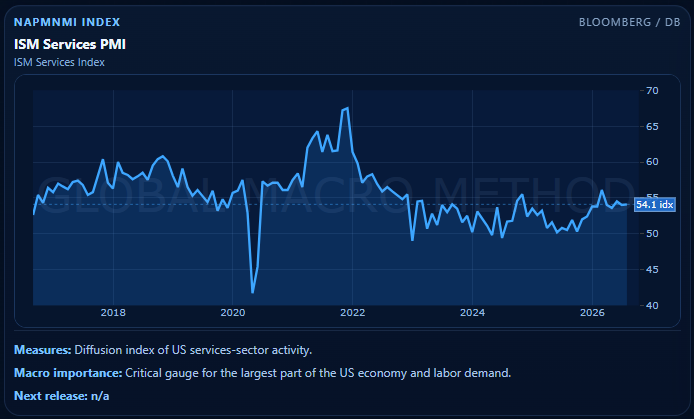
The services economy was similarly firm. The Services PMI held at 54.1, business activity accelerated to 59.1 and new orders rose to 57.2. The important divergence was employment, which fell back into contraction at 47.4.
This is the core US macro dilema.
Demand is not collapsing. Output is not contracting. Businesses are seeing enough activity to increase production and accept new orders, but they remain cautious about hiring.
That is not a standard recessionary mix. It is closer to an economy producing reasonable growth with less labour intensity, potentially reflecting productivity gains, automation, capital investment and greater corporate discipline.
For equities, that can be constructive because output and earnings are maintained without a comparable increase in labour costs.
For the Fed, it is more difficult. Strong demand means the central bank cannot automatically treat weak payroll growth as evidence that inflation pressure will disappear.
The Inflation Signals Remained Uncomfortable
Both ISM reports carried a clear inflation warning.
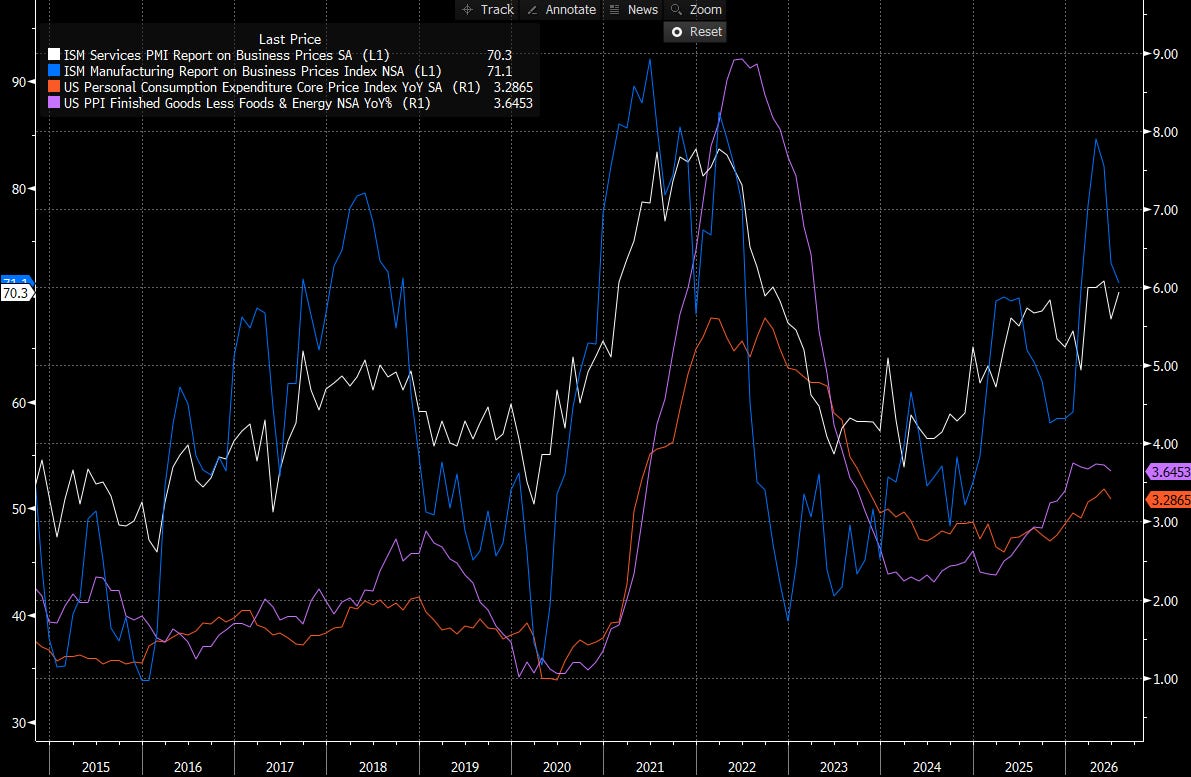
The manufacturing prices index remained extremely elevated at 71.1. ISM respondents continued to report pressure from steel, aluminium, tariffs and petroleum-related inputs. In services, the prices index increased to 70.3 and exceeded 70 for the fourth time in five months.
This does not guarantee a hot CPI print. The relationship between survey input prices and consumer inflation is neither immediate nor one-for-one.
It does, however, tell us that the inflation pipeline has not disappeared.
The fall in oil prices should provide some near-term relief, particularly if the Strait of Hormuz disruption continues to ease. But energy is only one part of the story. Tariffs, industrial inputs, transport constraints and services pricing remain relevant.
The economy is therefore not moving cleanly towards a low-growth, low-inflation environment. It is producing a more awkward combination of firm activity, weak hiring and persistent price pressure.
That is precisely the mix that makes monetary policy difficult.
Rates: The Front End Bought More Time
The Federal Reserve held the target range at 3.50–3.75% at its July meeting, but the 9–3 vote was unusually divided. Three policymakers preferred an immediate 25-basis-point increase, reflecting concern about elevated inflation and supply-driven price pressure.
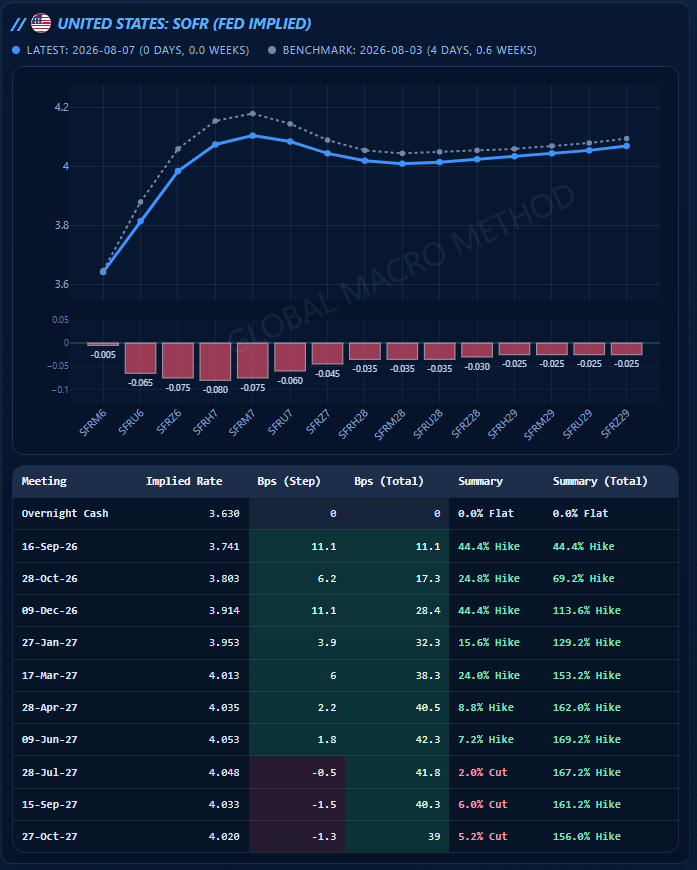
The payroll report reduced the urgency of that position.
Expectations for a September hike fell to around 44%, from 55% immediately before the employment report and 67% one week earlier. The two-year Treasury yield declined to around 4.20% on Friday, while the ten-year finished near 4.64%.
The front end outperformed because payroll weakness directly reduced the probability of an immediate policy move.
The long end rallied by less because its problem is different.
Ten-year and thirty-year Treasuries are being asked to absorb elevated inflation uncertainty, persistent fiscal supply, the possibility of renewed energy pressure and questions around the durability of foreign demand. Weak payroll growth can alter the expected timing of Fed policy without resolving any of those structural issues.
That is why I would not treat last week as the beginning of a straightforward duration rally.
The market bought a September pause. It did not receive confirmation that the tightening cycle is permanently finished, nor did it receive evidence that term premium should structurally compress.
Equities: Weak Data Were Bullish Because Earnings Remained Strong
US equities received the ideal combination of a lower discount-rate expectation and resilient corporate cash flows.

The S&P 500 gained 3.58% over the week, the Nasdaq rose 5.19% and the Dow increased 2.96%. The S&P finished Friday at a record high, while advancing shares outnumbered decliners by roughly 2.5 to one on the New York Stock Exchange.
Earnings provided the fundamental support. Of the 436 S&P 500 companies that had reported by Friday morning, 85.1% had beaten analyst expectations, well above the long-run average of 68%.
That allowed investors to interpret weak employment as a rates event rather than an earnings event.
The difference is critical.
Negative payrolls are bullish for equities only while the market believes slower hiring will stop the Fed without materially damaging consumption, revenues or profits. The moment labour weakness begins to threaten corporate earnings, the same data become risk-negative.
That transition has not happened yet. But with valuations elevated and the index back at record highs, the margin for disappointment has narrowed considerably.
The next stage of the rally also needs to be broader.
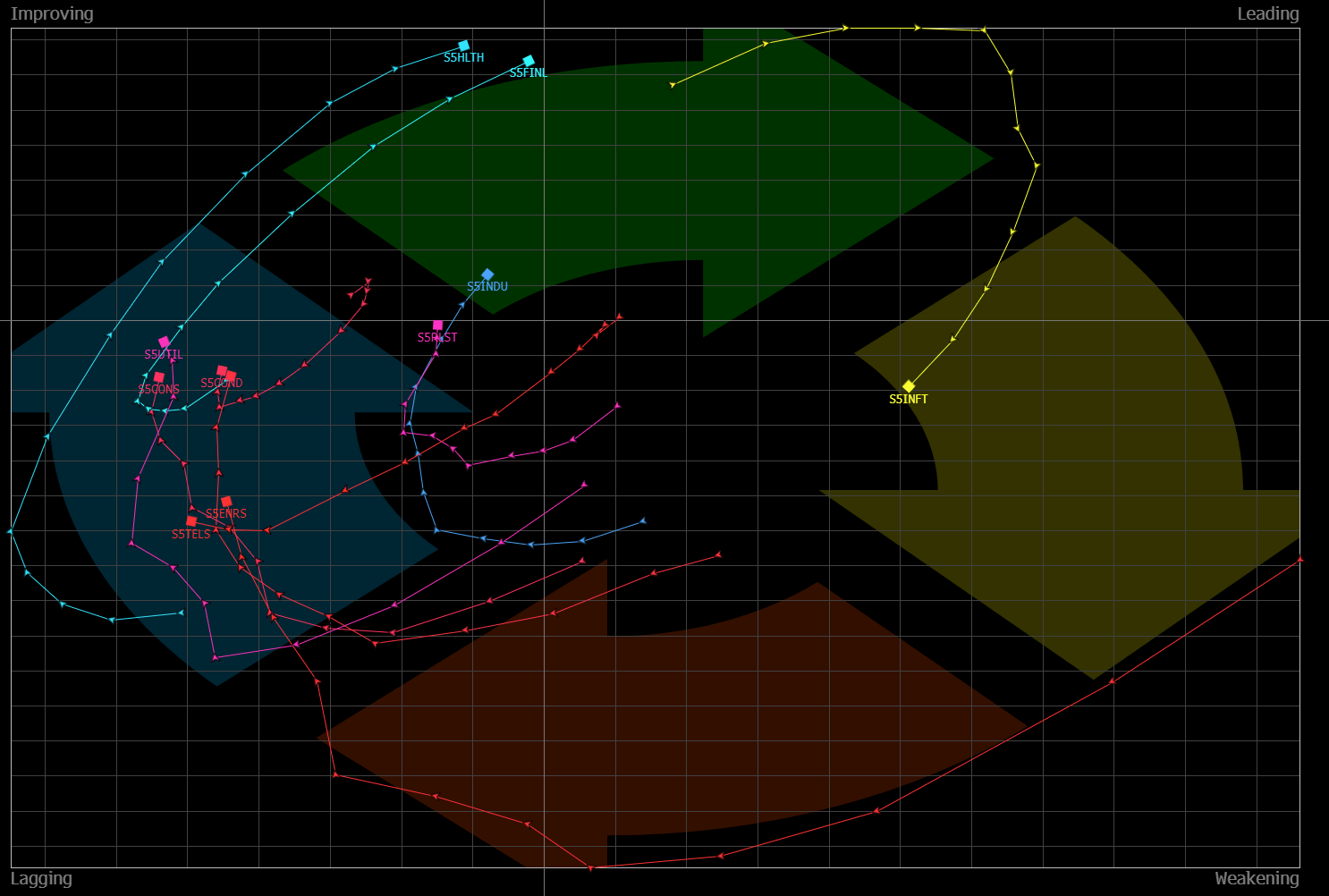
Technology and semiconductors remain the centre of index-level strength, but the healthier outcome would be a rotation into industrials, smaller companies and other economically sensitive areas as lower yields and lower oil improve the broader backdrop. Continued index gains accompanied by deteriorating breadth would leave the market increasingly dependent on a small number of earnings outcomes.
FX: The Dollar Weakened, but This Was Not a Break
The dollar index fell around 0.3% over the week and ended Friday close to 99.5. The euro rose to approximately US$1.157, while the dollar finished near ¥157.6.
The move was consistent with the decline in US front-end yields. A lower probability of a September hike reduced the dollar’s immediate rate advantage, particularly against currencies where domestic central banks remain cautious about declaring victory over inflation.
However, the dollar’s weekly decline was relatively modest compared with the size of the payroll surprise.
That suggests investors pushed out the timing of a Fed hike rather than fully abandoning the US exceptionalism or higher-for-longer narrative. US growth remains stronger than the payroll headline alone would suggest, while geopolitical uncertainty and weak fiscal positions elsewhere continue to support the dollar’s defensive role.
Gold’s gain of nearly 7% during the week was also notable. It reflected lower yields and a softer dollar, but it also showed that demand for geopolitical and policy hedges remains strong beneath the equity rally.
The market became more optimistic last week. It did not become complacent everywhere.
Below I look at why the US economy is increasingly separating output growth from employment growth, how CPI and Treasury supply will interact this week, the cross-asset implications of the main inflation scenarios, and what developments in Europe, the UK, Australia and Japan tell us about the durability of the dollar move.
More update coming to the GMM website for paid subscribers, global equities breadth and G5 complete rates dashboard, STIR, Bonds, Reals, Inflation, Nominals, Spreads and more! This alone is worth the cost!
