

Understanding the recent mega moves in rates, particularly in the US
I don’t think the main message from this reversal is that the market suddenly decided inflation was fine. My read is that the initial inflation shock forced investors to look harder at what expensive money was doing to the businesses carrying the growth story. As the selling spread through AI-related equities, government bonds started behaving less like another asset threatened by inflation and more like protection against the consequences of dealing with it. That interpretation fits the sequence, although the price action alone cannot prove exactly which investors drove the buying.
That brings together the two questions I’ve been working through recently. In Duration, Duration, Duration!, the argument was that parts of the curve could rally without the Fed declaring victory. In The Boom Is Real. So Is the Funding Bill., the question was whether the investment boom could keep generating enough return to justify its financing costs. This session put both questions on the same screen.
Macro Report: The Boom Is Real. So Is the Funding Bill.

Stuff im currently thinking about and what to keep in mind for the next while…

The important thing to consider or note, is that higher inflation can justify another hike while also making investors less confident about how much tightening the economy can ultimately absorb.
Those aren’t contradictory views. They’re different parts of the same process.
The reversal was bigger than the closing move suggests
The first reaction to CPI was straightforward. Bonds sold off, yields jumped, and the market put more weight on further Fed tightening. The ten-year Treasury yield reached 5.329%. By 3.19 pm New York time, it was back at 5.185%, a reversal of roughly 14 basis points from the high. Looking only at the modest net decline in yields misses how substantial that intraday change was.
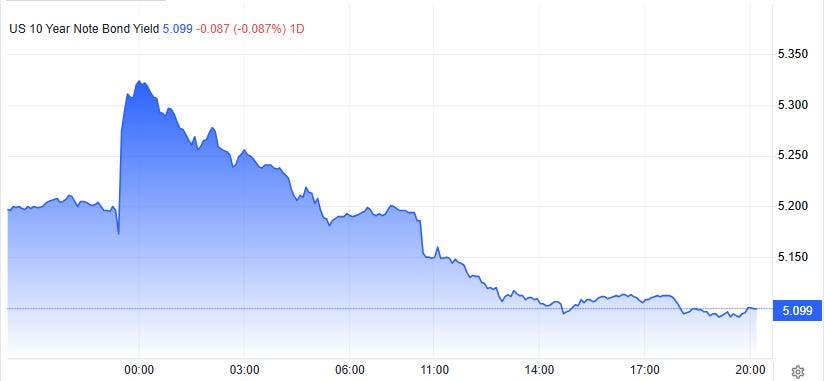
The rally then extended into Thursday’s Asian trading, with the ten-year reported around 5.11%. That took the decline from Wednesday’s post-CPI peak to approximately 22 basis points. That is a peak-to-subsequent-session move, not a 22-basis-point fall over Wednesday’s US session.
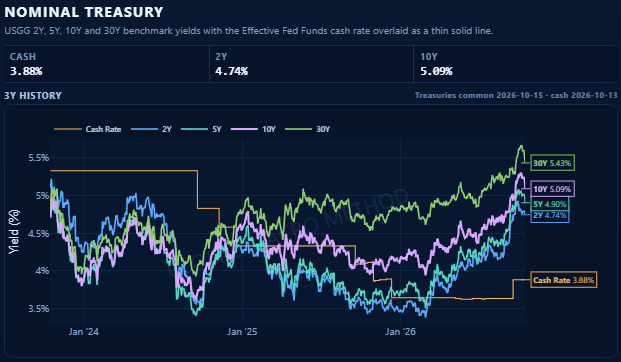
There is another qualification that matters even more for the macro interpretation. By Wednesday’s close, the whole curve had not delivered the same message.
The daily yield series put the two-year around 4.82%, against 4.79% on Tuesday, while the ten-year finished around 5.19%, against 5.21%. On those rounded readings, 2s10s flattened from roughly 42 to 37 basis points. The front end retained some of the inflation shock even as longer-duration bonds recovered.
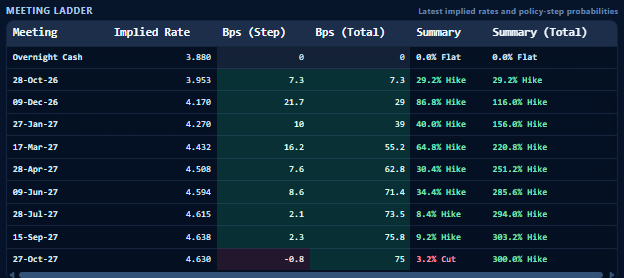
The meeting pricing told a similar story. October hike odds rising from about 22% before the release to roughly 39% during the initial adjustment, before finishing around 29.3%. The worst of the hawkish reaction unwound. The probability of a near-term hike still ended higher than it had started.
That makes “the market changed its mind and decided CPI was dovish” a poor explanation.
A better interpretation is that the release increased the chance of more restraint now, while the equity response increased concern about the consequences further out. The Fed can be more likely to hike at the next meeting without every subsequent year of expected interest rates needing to move higher alongside it.
For rate futures, the expiry matters. A rebound in a deferred contract is not interchangeable with a fall in next-meeting hike probabilities. The cash-curve evidence is clearer than any blanket claim that every part of the rates market completely rejected the inflation news.
Meanwhile, the S&P 500 fell 1.1% and the Nasdaq Composite lost 1.9%, with AI-related businesses among the main sources of weakness. The bonds recovered. The equity damage did not simply disappear with the lower Treasury yield. That divergence is where the useful information sits.
Discord launching in the coming day and much more!! Remember paid readers gain access to GMM website (www.globalmacromethod.com)
